
 English Orthography – The English Writing System
The written form of communication is perhaps the most problematic area of language learning for non-native English speakers.
The English Writing System
The word ‘orthography’ refers to the rules for writing a language, such as conventions of spelling and punctuation. In an alphabetic script, such as English, this definition also includes its grapheme-phoneme (letter-sound) correspondences.
English orthography is the alphabetic spelling system used by the English language. English orthography uses a set of rules that governs how speech is represented in writing.
English has relatively complicated spelling rules because of the complex history of the English language.
Most sounds in English can be spelled in more than one way and many spellings can be pronounced in more than one way.
The English language contains 24 to 27 (depending on dialect) separate consonant phonemes and between fourteen to twenty vowels and diphthongs. However, English only uses the twenty-six letters of the Latin alphabet.
For this reason, a one to one correspondence between character and sound is not possible to denote for all the complex sounds. This means that the letters have to multi-task!

Explore Genre, Form and Register of Writing in English
Phonemic representation
The letters in English orthography represent a particular sound. Single letters or multiple sequences of letters may provide indication of other sounds, such as ‘sh’, ‘ch’, ‘th’ or ‘ph’.
Thus, the single letter ‘d’ in the word ‘dog’ represents a single sound, whereas in the word ‘shout’), we use the digraph (two letters) ‘sh’.
We also sometimes use three letters to make a sound, such as in the word ‘scotch’, the three letters ‘tch’ indicate the correct pronunciation. Sometimes four letters can also make a common sound, such as ‘sion’ or ‘tion’ as in ‘television’ and ‘attention’.
Confusing pronunciations from English spellings
The same letters may indicate different sounds in English orthography.
For example, the digraph ‘ch’ represents the first syllable in ‘church’ and ‘cheese’, but when used in the words ‘character’ and ‘chorus’ the ‘ch’ diagraph is pronounced differently (a hard ‘c’ or ‘k’ sound), to rhyme with ‘court’.
Other examples include ‘ph’ sounding like ‘f’ (e.g. the diagraph ‘ph’ in ‘telephone’ and ‘graph’ perform the same function as the ‘f’ in ‘golf’ and ‘beef’ and ‘yourself’).
The use of these alternative, more complex spellings for these sounds often mean that the words have been borrowed from Greek.
Often the pronunciation of a set of letters is dependent on where the letters occur within a word.
For example, in the words ‘laugh’ and ‘cough’, the diagraph ‘gh’ is pronounced like an ‘f’, because it is at the end of the word.
However, when used in the words ‘Ghana’, ‘ghetto’ or ‘ghost’, the diagraph ‘gh’ rhymes with the ‘g’ in ‘garden’, (a hard ‘g’) because it is used at the start of the word.
The diagraph ‘gh’ in English orthography can be used in many circumstances with different pronunciations, however, such as in the words ‘high’, ‘through’ and ’borough’. The last two words here are part of the notorious ‘ough’ letter combination.
Ough Words
The English language has quite a weak connection between the written form of a word and the spoken form of that word. For example, the letter combination ‘ough’ can be pronounced in many different ways depending on the rest of the letters surrounding it.
The the words ‘bough’, ‘trough’, through’, thorough’, ‘enough’ all contain the letters ‘ough’ yet have a different pronunciation. This can seem very confusing and illogical to EFL learners.
Ough words
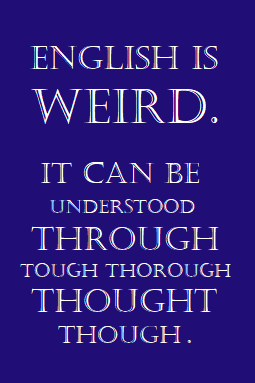 § tough: /ʌf/ as in cuff;§ though: /oʊ/ as in toe;
§ cough: /ɒf/ as in off;
§ plough: /aʊ/ as in cow;
§ through: /uː/ as in threw;
§ nought: /ɔː/ as in caught;
§ thorough: /ə/ as in about or mother (British English);
§ hiccough (a now uncommon variant of hiccup): /ʌp/ as in up.
The letter ‘x’
Rarely, a single letter is used to represent multiple sounds. A useful example of this is the letter ‘x’, which normally represents the two letters ‘ks’ when sounded together, for example in the word ‘expect’.
The letter ‘y’
When representing a vowel, the letter ‘y’ in final positions represents the sound ‘ee’ in words which have been borrowed from Greek. However, the letter ‘i’ is usually used to represent this sound when used in non-Greek words.
Thus, the word ‘myth’ is of Greek origin, while ‘pith’ is a Germanic word. Both words rhyme and the ‘y’ and the ‘i’ perform the same function. It is their origin which alters the representation of the sound in English orthography.
Homophone differentiation
Spelling may also be used to distinguish between English homophones (words with the same pronunciation but different meanings).
For example, the words ‘hour’ and ‘our’ are pronounced identically in some accents. However, they are distinguished from each other in English orthography by the addition of the letter ‘h’.
Another example is the pair of homophones plain and plane, where both are pronounced the same but their difference in meaning is marked by their different orthographic representations.
This difference between homophones is not always clear in English spelling and in these cases you will have to work it out from the context.
For example, the word ‘bare’ means unadorned or with no clothes on. However the word ‘bear’, sounding identical to ‘bare’, can mean the big, grizzly animal or the verb ‘to bear’ meaning ‘to endure’ or ‘to carry’.

Don’t get bare confused with bear! – image source
Another example of unresolved homophones in English orthography is the word ‘bay’, which has many meanings (i.e. a recess, a parking space, a kind of herb, a wide inlet of sea, a noise from an animal, a kind of tree and a colour).
These kinds of words are called homographs in English orthography because they have different meanings but the same spelling.
Hyphenation in English orthography
The hyphen is a punctuation mark used in English writing that is used to keep two words or phrases together. It shows the reader that two words are linked, whether that is to create a new word or simply to aid clarity.
Hyphens are used with compound adjectives, that is, adjectives that are made up of two or more words. For example: ‘state-of the-art television’, ‘two-seater car’, ‘five-page book’, ‘well-written essay’, ‘end-of-term disco’, ‘seven-year-old child’, ‘high-flying career’.
Be careful not to hyphenate all adjectives in a list. For example, take the sentence: ‘the small, frightened, ginger cat ran up the long, dark, concrete path’. In this sentence, each adjective here stands alone and is not compounded with any other adjective.
If we changed the sentence to include compound adjectives, it could read like this: ‘the short-tailed ginger cat ran up the pitch-dark, tree-lined path’.
Hyphens are also used with compound verbs, that is verbs that are made up of two or more words. These compound verbs are often creative and humorous. For example: ‘she fast-talked her way out of the situation’.
Hyphenation is used for clarity too. For example, in the sentence: ‘the pub has an old-world charm’, the hyphen tells the reader that the pub’s appeal lies in its ‘old world’ charm.
If we had not used the hyphen, it could mean that the pub’s ‘world charm’ is old. In other words, it can sometimes difficult to tell which words are the adjectives if we don’t use hyphens.
A trick to tell if you need a hyphen or not is to put the word ‘and‘ between the adjectives. If it still makes sense, then you don’t need a hyphen.
Here are two more confusing sentences where hyphens are necessary:
‘She enjoyed her new-found freedom’ – without the hyphen it could mean her ‘found freedom’ is new.
‘They had a long-standing friendship’ – without the hyphen it could mean the ‘standing friendship’ is long.
‘The red-brick building’ – without the hyphen it could mean the ‘brick building’ was red, when we actually mean the building is made from ‘red brick’ (a type of brick).
‘The Old-English professor’ – without the hyphen it could mean the ‘English professor’ is old (we could also mean the old professor is from England), when we really want to talk about a professor who is a specialist in ‘Old English‘.
Prefixes and Hyphens
Prefixes are hyphenated in English writing when it would be confusing to leave the hyphen out. For example: ‘He re-covered the chair’ means he put a new covering on the chair.
If we had written ‘He recovered the chair’ without the hyphen, this would mean that he found the chair again (after having presumably lost it).
In Old English, hyphenation was very popular. Many words used to be hyphenated, which we would never hyphenate today – even the word ‘to-day’!
Silent letters in English
There are many spellings in the English language which do not look at all like they sound. There are functionless letters, such as the ‘b’ in ‘debt’ (from Latin ‘debitum’) the ‘s’ in ‘island’ (from the Latin insula instead of the more useful Norse igland).
This is one of the most troublesome areas of English orthography and English phonology, where sounds and spellings do not correspond.
Some letters have no linguistic function. The letter ‘e’ is soundless at the end of most English words. (For example, ‘give’, ‘have’, ‘grave’). This is especially common with words ending in ‘ve’ where the final sound is the ‘v’ not the ‘e’. It also happens with the word ‘name’.
When an ‘e’ is sounded, it usually denotes that the word is of foreign extraction, for example, when using an accent on words such as ‘cafe’.
Interestingly, the end letter ‘e’ used to be pronounced aloud in Middle English. The last letter changed to become silent during the Great Vowel Shift of the Early Modern period, which paved the way for Modern English.
Read more about silent letters in our phonology section.
Multiple functionality in spelling
The letter ‘c’ is usually pronounced like ‘car’, cash’, ‘crazy’ (a hard ‘c’), but when used before the vowel ‘i’ is changes to sound like an ‘s’. This can be seen in the words ‘circle’, ‘cinema’, ‘cider’, ‘circus’, cigarette’ and ‘city’.
Explore this section further to learn more about English punctuation and genre, form and register in English writing.
Explore more about the connection between spelling and pronunciation in our English phonology section.
Discover how the English writing system was shaped by England’s history in our History of English section.
Share your thoughts on English orthography
Do you find writing in English the hardest language skill to develop?
Which areas of the English writing system do you find the most difficult to learn?
Can you think of more important words that are spelled completely differently in English to how they are pronounced? Have any of these words caught you out?
Do you have any tips for studying English orthography?
Please advice what is the origin of the English ortography: Latin, Greek, Arabic???
Thank you
see also:
Beneath the Surface of Words: by Sue Hegland https://learningaboutspelling.com/2021/12/07/beneath-the-surface-of-words/
American English Spelling Don W. Cummings http://www.dwcummings.com/
The purpose of an orthography is to communicate meaning not transliterate.