The First English Dictionary
 The Development of the English Dictionary
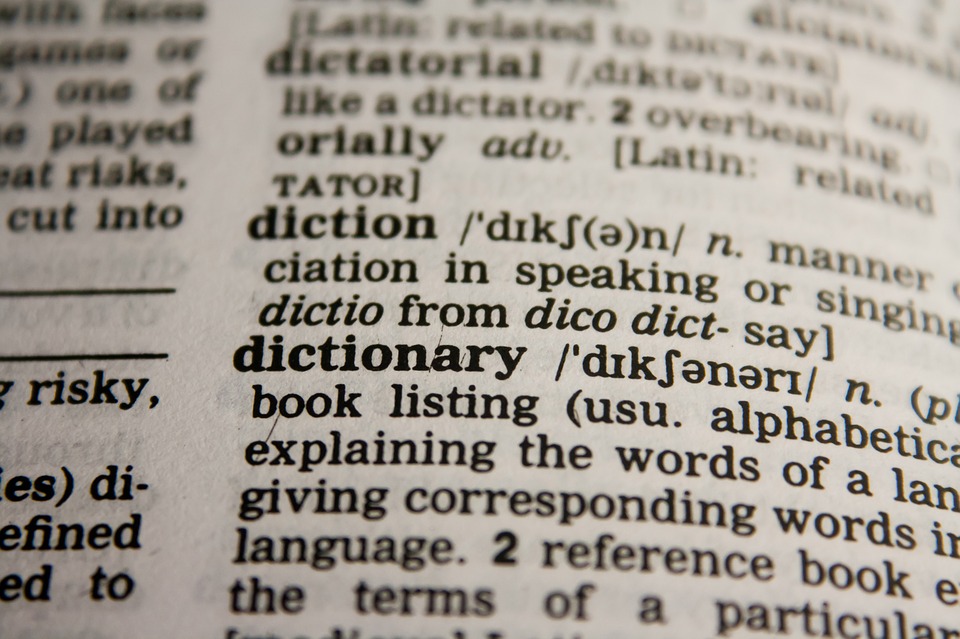
Although the printing press made standardising English spelling much easier, it was not until 130 year later with the arrival of the first English dictionary that people could confirm the formal correctness of a written word.
Dictionaries provided readily verifiable, written confirmation of the rules of English spelling.
Due to the development of the English dictionary, the Early Modern period saw a significant breakthrough in the standardisation of the English language.
Robert Cawdrey’s A Table Alphabeticall
The first English dictionary, A Table Alphabeticall, was compiled by English school teacher, Robert Cawdrey and published in London in 1604. However, it was found rather unreliable.
The first edition of the dictionary was just 120 pages long and contained only 2,543 words, many of which were obscure.
The primary focus of Cawdrey’s work were those words he thought of as ‘hard’ for the general public because they had foreign roots. This meant that most common words were not included.
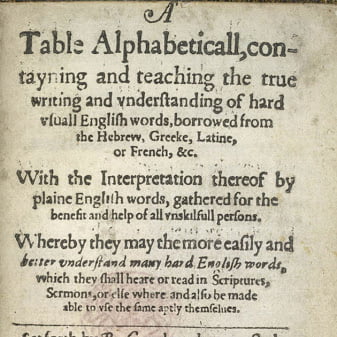
Spelling checks with brief definitions
Another problem for Cawdrey’s dictionary was that its definitions were very brief and often consisted of only one word, making it more a book of synonyms than a useful academic reference.
Although the reader could check their spelling using the dictionary, they had no way of finding out what the word actually meant or how it should be used.
Despite its shortcomings, Cawdrey’s A Table Alphabeticall proved quite popular, and ran into four editions. Each edition increased in length with the final edition in 1617 containing a total of 3,264 words.
The last surviving first edition of Cawdrey’s dictionary can be found in the Bodleian Library at the University of Oxford, which is one of the oldest libraries in Europe.
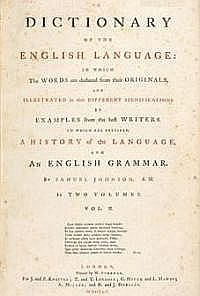
Samuel Johnson’s A Dictionary of the English Language
It was not until 1755 when Samuel Johnson produced A Dictionary of the English Language that the dialect of London became the official English standard.
Johnson’s comprehensive dictionary took seven scholars eight years to complete.
The resulting reference work listed 40,000 words and contained detailed definitions, illustrations and quotations to fully explain the background of each word and its usage.
This dictionary was a great achievement. Johnson spearheaded the idea of using literary quotations to aid in the definitions, making liberal use of the works of Shakespeare and Milton.
Despite Johnson’s own opinions and idiosyncrasies coming through on every page, his dictionary proved hugely popular and was highly respected.
Insights into language usage
With Johnson’s reliable English dictionary, people could now find out exactly how to spell many common and uncommon words in the English language, as well as gain insight into their proper usage, historical background and literary use.
The official spellings and definitions of English words had at last been declared and the spelling of the English language had become standardised.

This standardisation helped push the English language towards the Late Modern period and the English language that we all know today.
A common question for people researching the English dictionary is what is the first word in the English dictionary? Well the answer is ‘A’, which is an indefinite article (e.g. ‘a cow’), a letter name (the letter A), and a grade (e.g ‘she got grade A in her exam’).
The first full word in the English dictionary is often ‘Aardvark’, which is an African mammal that eats ants and termites.
Share your thoughts on the first English dictionary
- Have you ever seen a copy of Cawdrey’s or Johnson’s dictionary?
- Do you think the authors of the dictionary should include their own opinions and comments or stick to the facts?
- What percentage of a language’s words do you think need to be included in a good dictionary?
- Would you find literary quotations useful when looking up a new word?
- Do you think dictionaries should describe how people actually speak, or how they should speak?
- If you were creating a dictionary, what types of information would you like to include (e.g. pronunciation, examples, word origins)?
Next: Late Modern English
Attributions
- Volume Two of Samuel Johnson’s A Dictionary of the English Language title page. By Samuel Johnson 1709-1784 [Public domain], via Wikimedia Commons
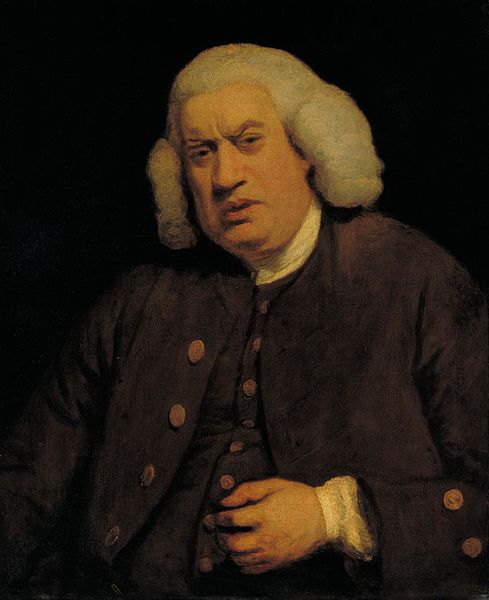
- Portrait of Samuel Johnson by Joshua Reynolds, 1772, commissioned for Henry Thrale’s Streatham Park gallery. [Public domain], via Wikimedia Commons

