
Academic English

Academic English: Essay Writing, Formal Style & Referencing
Academic English is the style of language used in universities, colleges and research writing. It’s more formal and structured than everyday English, and it follows certain conventions that help communicate ideas clearly and objectively.
Types of academic writing include essays, reports and dissertations. Understanding academic style will help you present your thoughts in a professional and credible way.
Explore Academic English Guides
Discover how to structure strong university essays and cite your sources accurately below.
Essay Writing
Learn how to plan clear introductions, build cohesive body paragraphs, use formal linking words and write strong academic conclusions.
Academic Referencing
Understand why citations matter and master Harvard, APA and MLA referencing styles to support your arguments and avoid plagiarism.
Academic English Style
Unlike conversational English, which often includes contractions, slang and personal opinions, academic English avoids informal expressions and focuses on evidence and reasoning.
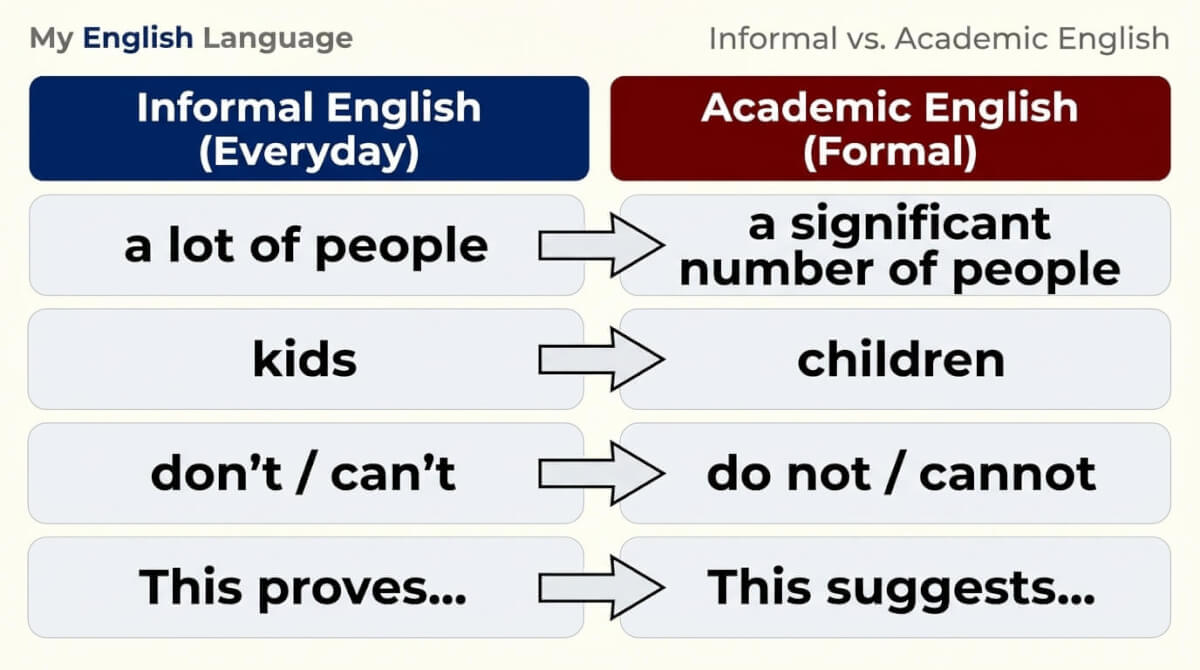
The sentences tend to be more complex, using linking words and precise vocabulary to show relationships between ideas. Instead of saying “lots of,” for example, you might write “a significant number of” or “a considerable amount”, and instead of saying “like” you might say “such as” when introducing an example.
Academic English values clarity, logic and balance. Writers aim to express ideas carefully, often using cautious language to avoid making absolute statements. For example, instead of saying “This proves that…” you might want to say “This suggests that…” or “The results indicate that…”
Using the right tone and structure helps your writing sound thoughtful and well-reasoned.
Academic English has its own vocabulary and you will encounter certain words at university or in other academic contexts that are not usually seen elsewhere.
Using the correct type of academic English can feel daunting to non-native speakers, as this language usage is more formal than regular English. We hope this guide can help you feel more confident using formal academic style.
Academic Vocabulary
Here are some examples of academic vocabulary and words related to academic study and writing:
- Essay, dissertation, thesis, theses, references, bibliography, referencing system, Harvard system, footnotes
- Appendix, appendices, introduction, main body, conclusion, argument, thesis statement, paragraph,
- Submission, deadline, extension, module, finals
- Degree, bachelors degree, Master’s degree, doctorate, PhD
- Lecturer, reader, researcher, professor, tutor, teacher
- Lecture, seminar, halls of residence, students’ union
- Semester, term, academic year
When using the English language for academic purposes it is more important than ever to ensure grammar, spelling, punctuation and style are all correct.
Academic writing uses formal language and academic essays follow a special pattern in structure, in addition to using particular kinds of referencing.
When using academic English, it’s important to focus on formal language, avoid slang and use precise vocabulary. Also pay close attention to academic verbs like analyse, compare, justify and define, as these tell you exactly what examiners expect.
Use the resources on this page to guide your writing and practise regularly to become more proficient using English for academic purposes.
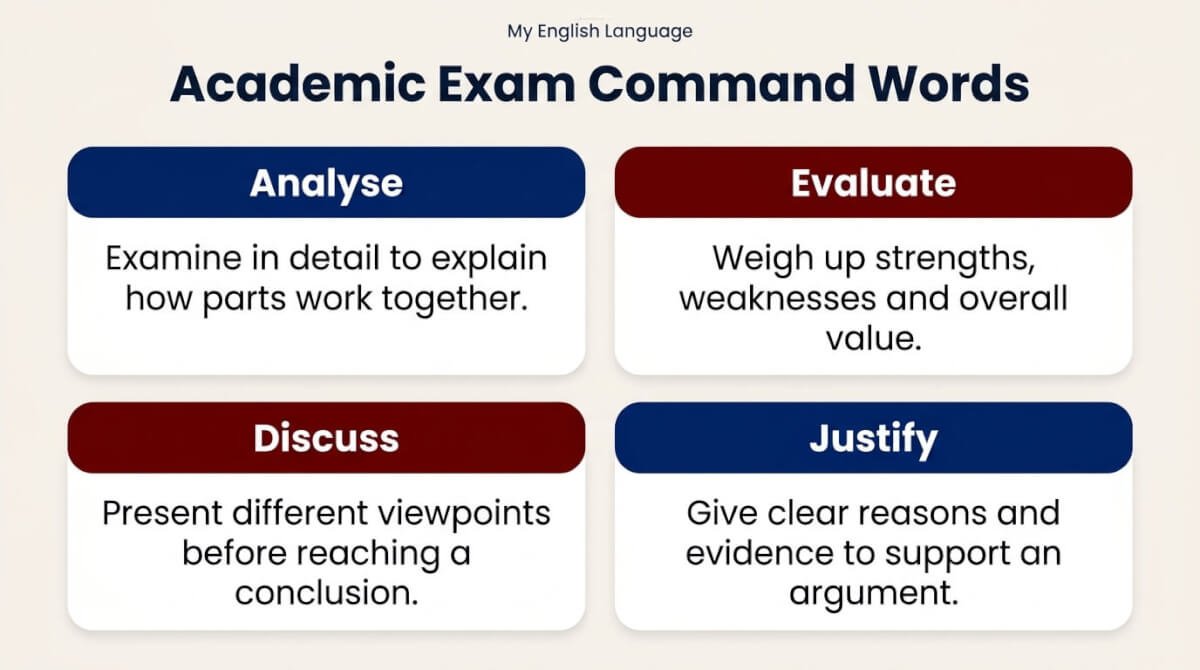
Exam Command Words & Essay Vocabulary
There are some academic verbs and other command words that are often used in university exam questions or essay questions to ask you to address an issue. The words used tell you what kind of answer the examiner expects:
- Assess – To evaluate or judge the quality, importance, or value of something.
- Evaluate – To judge the strengths and weaknesses of something.
- Discuss – To write about different points of view or arguments before reaching a conclusion.
- Analyse – To examine something carefully and in detail in order to understand it or explain it.
- Define – To explain the exact meaning of a word, phrase or concept.
- Summarise – To give a short account of the main points or ideas.
- Outline – Give a general summary of the main points.
- Contrast – To show the differences between two or more things.
- Compare – To look at two or more things and identify their similarities.
- Compare and contrast – Discuss both similarities and differences.
- Justify – To give reasons or evidence to support an argument or decision.
- Illustrate – Use examples to show or clarify an idea.
- Argue – To present reasons or evidence in support of an idea, theory or opinion.
- Explore – Consider a topic from several angles or perspectives.
- Conclude – To bring something to an end by forming a final judgement or opinion.
- Propose – Suggest a plan, idea, or theory.
- Interpret – To explain the meaning or importance of something.
- Imply – To suggest something without saying it directly.
- Convey – To communicate or express an idea, feeling or meaning clearly.
- Critically – In a way that involves careful evaluation and questioning, not just description.
Here are some examples of exam questions or university essay questions using some of the language from the list of words above:
- Analyse how the poet uses imagery and rhythm to convey emotion in the poem.
- Discuss the advantages and disadvantages of studying abroad for university students.
- Evaluate the impact of social media on young people’s communication skills.
- Compare two poems that explore the theme of nature, focusing on the writers’ use of imagery.
- Compare and contrast the education systems of the UK and another country of your choice.
- What does the author imply about the causes of climate change in the article?
- Define the term globalisation and explain its significance in modern economics.
- Justify your choice of research method by explaining why it is the most appropriate for this study.
- Interpret the ending of the novel and explain what it implies about the author’s message.
Formal Academic Writing Rules
Academic writing is always formal in style. It’s best to avoid the use of idioms, colloquial phrases, constricted versions of words using apostrophes (for example: don’t, didn’t, haven’t) or informal words, phrases or slang.
Words or phrases like “a lot of,” “kids,” “stuff,” or “cool” are fine in conversation, but they do not convey precision or professionalism in academic writing, such as essays, reports or assignments.
Instead, use formal, precise language. For example:
- Replace “a lot of people” with “many people” or “a significant number of people”.
- Replace “kids” with “children”.
- Replace “get” with “receive,” “obtain,” or “achieve”, depending on context.
Avoid contractions like “don’t,” “can’t,” or “it’s” in formal writing. Instead, use “do not,” “cannot,” and “it is”. Formal writing should be clear, objective and professional. This all helps you sound credible and ensures your ideas are taken seriously.
Academic English writes words in full and normally structures sentences within paragraphs and paragraphs within longer bodies of work, such as essays and dissertations.
It’s all about making sure your ideas are put across carefully and precisely, showing you in a serious light.
Academic written work will normally be heavily structured to display your argument. Arts, Humanities and Social Science subjects will normally use essays, while Natural Science subjects may use reports.
Academic Essay Structure
Academic essays and dissertations follow a clear, logical progression so readers can follow your argument from start to finish:
- Introduction & Thesis Statement: Introduces your topic, sets the context and ends with your main research question or argument.
- Literature Review: Surveys key published research on your subject and shows how your work fits into existing knowledge.
- Main Body: Develops your argument across structured paragraphs or chapters, supporting each point with evidence.
- Conclusion: Summarises your key findings, answers your thesis question and offers final closure without simply repeating the introduction.
- Appendices & Bibliography: Houses supporting charts or transcripts alongside a complete list of cited sources.
For a full step-by-step walkthrough, including brainstorming, creating an outline and writing strong thesis statements, read our dedicated guide on how to structure an academic essay, and check our academic referencing guide to format your citations accurately.
Academic English Lesson Ideas
Here are some ideas for practising academic English in a TEFL class:
Academic Verb Challenge
Students choose 5 academic verbs (e.g. analyse, compare, justify, evaluate, interpret) and write a couple of sentences using each verb in an essay context. They swap or compare with a classmate or the teacher to check clarity and correct usage.
Informal to Formal Rewriting Task
Take a short paragraph of casual writing (from a diary, social media or conversation) and identify the slang, contractions or vague words it contains. Students can rewrite it in formal academic English using precise vocabulary and formal structures.
Mini Essay Practice
Pick a simple question (e.g. “Compare two novels or films you like”) so students can plan a short essay using headings, such as Introduction, Comparison, Differences, Conclusion. The focus should be on using academic verbs, linking words (however, moreover, in contrast) and formal language.
Share Your Thoughts on Academic English
- Do you find any academic expressions confusing?
- Why do you think academic writing avoids slang and contractions?
- Which part of academic writing do you find most challenging: vocabulary, structure, linking ideas or formal style?
- Which academic verbs (like analyse, compare, justify) do you feel confident using and which ones do you find tricky?
- Do you have any tips on learning formal academic writing?
- Teachers, do you have any tips for teaching academic style to non-native learners?
Let us know your thoughts on academic English writing in the comments.