Money

Talking About Money in English
Money vocabulary is useful for everyday life when talking about cash, prices and spending. This page covers the words and expressions you need to talk about money in everyday situations when shopping, comparing prices or discussing value for money.
You’ll also find some useful money idioms and expressions, old-fashioned and historical British money terms, and example sentences to help you use the vocabulary in context.
Money vocabulary and phrases
Prices and costs
Cheap – inexpensive
Expensive – costs a lot
Reasonable / fair price – not too expensive, worth the money
Affordable – you have enough money to buy it
Overpriced – costs more than it should
Good value (for money) – worth the price you pay
A bargain – something bought for a very good price
On sale / in the sale – being sold at a lower price than usual
Discount – a reduction in price
Half-price – 50% off
Special offer – temporary lower price or deal
A rip-off (slang) – too expensive for what it’s worth / not good value
Types of payment
Cash – physical money (notes and coins)
Card – bank card or credit card
Contactless – paying by tapping your card/phone on the machine
Change – money returned after paying (e.g. “Here’s your change”)
Coins / notes – types of money (coins are metal; notes are paper)
Receipt – written record of payment (receipts are sent from seller to buyer after payment is received)
Invoice – a statement of services provided and the money owed (invoices are sent as a request for payment, from the seller to the buyer)
Pay by installments – pay in parts over time
Money actions
Withdraw money – take money out of a bank
Deposit money – put money into a bank
Transfer money – move money to someone else’s account
Spend money (on …) – use money to buy
Lend money – give money on loan (i.e. you expect it to be paid back)
Borrow money – take money from someone, expecting to return it
Owe money – need to pay someone back
Save (up) – collect money over time to buy something
Afford – to have enough money to pay for something without difficulty
Waste – to spend money on something worthless / without much benefit
Earn – to get money in return for something you have done (e.g. work)
Invest – to put money into something (stock market or property) to make more money later
Profit – the overall financial gain; the amount of money earned after paying all costs
To set [someone] back (slang) – to cost (e.g. “That coat set me back £100”)
Example money phrases
- How much does it cost?
- That’s too expensive – I can’t afford it.
- Do you accept cards?
- Can I get a receipt, please?
- Is this on sale?
- It’s good value for money.
- I need to withdraw some cash.
- Where is the cash point / ATM?
- Don’t buy that old car – it’s a complete waste of money!
- She invested money in the stock market.
- He earned a good salary from his job.
- That must have set him back a few bob!
- I transferred the money using Revolut.
- He borrowed £10 from me, but he hasn’t paid me back yet.
- I lent him £20 to buy a take-away.
Borrow and lend
Be careful with the words “borrow and “lend”. These words have opposite meanings. You “borrow” money from someone, but you lend money to someone.
- If you borrow money from someone, they give you money and you pay them back later.
- If you lend money to someone, you give them money and they pay you back later.
Sometimes, English speakers get these mixed up! You might hear an incorrect sentence, such as “I borrowed him £10 yesterday” instead of “I lent him £10 yesterday”; or “Can I lend £10 off you?” instead of “Can I borrow £10 from you?” Note the correct preposition here is “from”, not “off” – this is another mistake you might hear.
Slang to describe something expensive
- Pricey
- Cost a fortune
- Cost an arm and a leg
- Cost the earth
- Break the bank
- Top dollar
- A king’s ransom
Slang to describe something cheap
- Cheap as chips
- Cheap and cheerful
- A bargain
- Dirt cheap
- A steal
- Easy on the pocket
Describing financial status
Words to describe being rich
Well-off – To be very comfortable financially, to have enough money with plenty to spare
Wealthy – To be quite rich, to have plenty of money with a lot to spare
Rich – to be very wealthy with lots of money
Rolling in it (slang) – rich
Loaded (slang) – rich
Words to describe being poor
Poor – to not have much money, to be in a difficult financial situation
Hard up – poor
Struggling – financially hard up
[Living] Hand to mouth – poor, just managing to eat
[Just about] Making ends meet – only just getting by / managing with difficulty
[Just about] Getting by – managing with difficulty
Living pay cheque to pay cheque – having no money left at the end of each month
On a [tight] budget – being very careful with money, trying to spend as little as possible
Slang words for money in England
When talking about money, it is useful to know some slang words people use, so you can understand native speakers. No money vocabulary guide could be complete without a look at slang expressions!
Some slang words for money include:
Cash, coin, notes, dough, loot, dosh, bread, wad, moolah, wonga, lolly, readies, smackers
“a wad of cash”
a fiver (five pounds), a tenner (ten pounds), twenty quid (twenty pounds)
five nicker – five pounds
fifty notes – fifty pounds
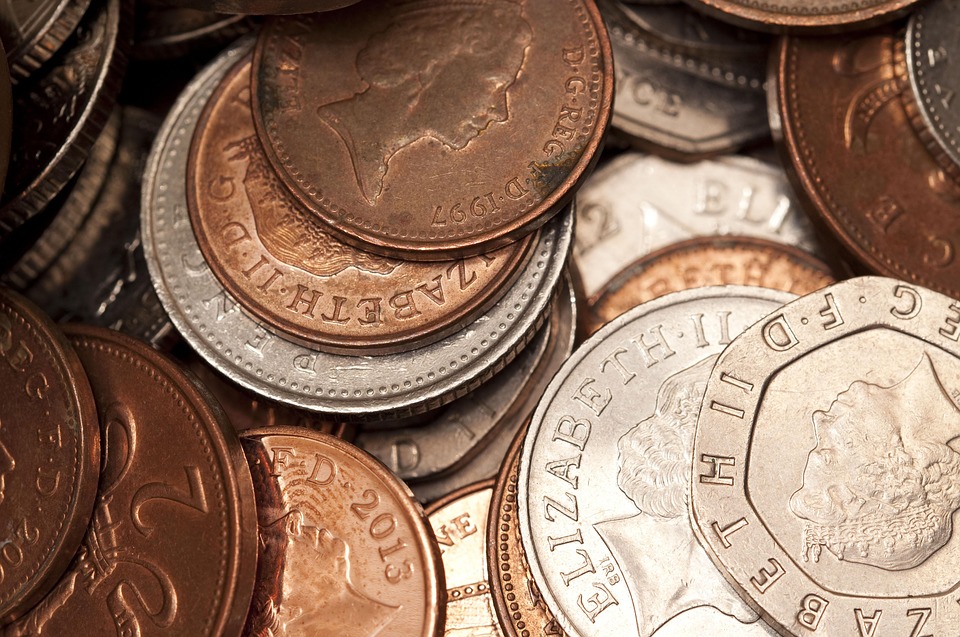
coppers – pennies (1p and 2p are coppers – literally copper coloured instead of silver)
a ton – a hundred pounds
a grand – a thousand pounds
a monkey – 500 pounds
a pony – 25 pounds
English idioms using money
There are lots of slang expressions and idiomatic phrases in English that use money vocabulary and words related to banking and finance. Here are some common money idioms using words related to finance:
(to be) in the black – you are in credit (a financially good situation)
(to be) in the red – you are overdrawn (a financially bad situation)
- In the black/red are expressions often used to talk about businesses
to bring home the bacon – to earn money
a cash cow – something that makes you a lot of money
gravy train – a job that is easy and pays well (e.g. ‘to be on the BBC gravy train’ – to work for the BBC – implying that the company pays really well for little work)
to hit the jackpot – to do well (e.g. ‘you really hit the jackpot with that job’) – a jackpot is the biggest prize in a casino game
to make a killing – to make a lot of money from an investment or deal
to be on the money – to be correct about something (e.g. a person can be ‘right on the money’ if they make a correct prediction about an event)
to pay peanuts / to be paid peanuts – to pay poorly / to be paid poorly (if a job ‘pays peanuts’ it does not pay well)
to bet your bottom dollar – to be sure of something / to be certain that something is true (e.g. ‘I’d bet my bottom dollar they’ll go to France on holiday’)
a nest egg – your savings (your nest egg is usually money that is saved for the distant future)
to fork out – to pay a lot of money (e.g. ‘he forked out 500 quid for that!’)
to cost an arm and a leg – to cost a lot of money
highway robbery – to cost a lot of money, over-priced (‘£50 for a bottle of wine? That’s highway robbery!) –
- Highway robbers were robbers who used to wait on the roads to rob rich people passing in their carriages from the Elizabethan era until the 19th century
- Highwaymen were famous for the phrases: “Stand and deliver!” (e.g. “Stand and deliver your money/your purse!”) and “Your money or your life!”
- Hounslow Heath near London was infamous for its association with highway robberies, where robbers worked on the Bath and Exeter roads
- One of the most famous English highwaymen was Dick Turpin. He was executed in York in 1739
to cash in (on something) – to take advantage of a good opportunity, often financially
to chip in (on something) – to pay your share for something, to pay for part of a purchase along with other people who are also ‘chipping in’
to scrape together – to manage to find enough money – to get enough money together with difficulty (e.g. “I managed to scrape together £100 to pay for the expensive car repairs”)
to scratch around (for money) – if you are “scratching around for money”, you are poor or finding it difficult to earn enough money
to get by – to survive, to earn just enough to manage (e.g. “Do you make enough money to be comfortable?” “I manage to get by”.)
to make ends meet – to get by, to survive on just enough money (“He sometimes finds it hard to make ends meet on his low wage”.)
as cheap as chips – something that is very cheap
cheapskate – someone who is always trying to save money and never likes to spend any – a negative term (also a “stingy” person)
to be broke / to be skint – to have no money right now (refers to a temporary situation)
to be hard up – to be poor, to have little money
to be rolling in it – to have lots of money
to be loaded – to have lots of money

Slang words for money in the USA
a buck – a dollar (five bucks – 5 dollars)
a ten dollar bill – a ten dollar note
a dime – 10 cents
a nickel – 5 cents
a quarter – 25 cents
green – slang for money (American dollar notes are printed using green ink)
greenback – American dollar note

British old money
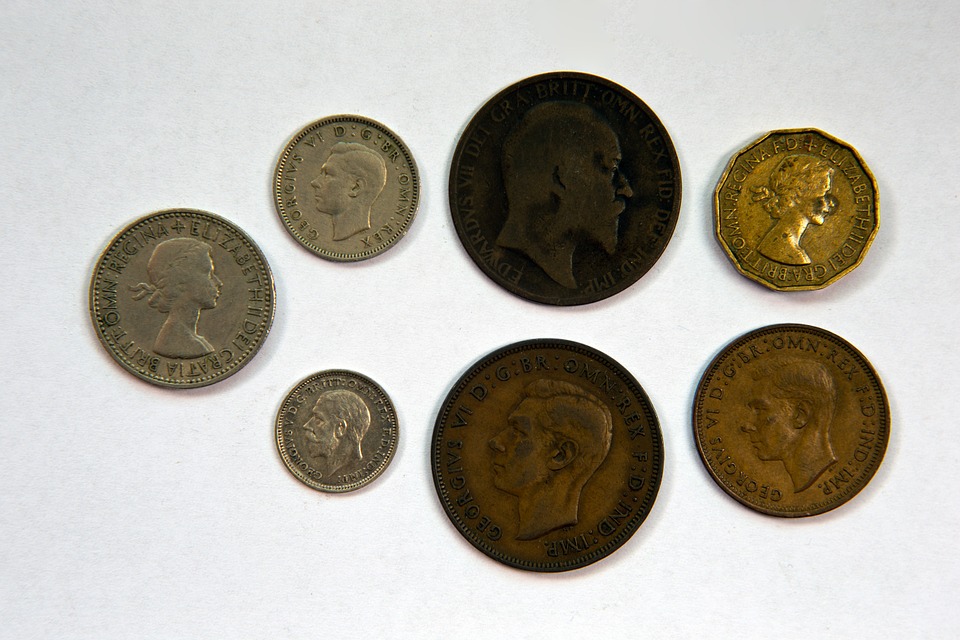
Before 1971, the UK banking system used old money – pre-decimal currency. Instead of pounds and pence being used in a decimal system, the country used pounds, shillings and pennies and it was all devised around the number twelve.
There were many different coins and monetary amounts with their own special names – this old system can seem very complicated to people today!
Under the old system of money in the UK, there were 12 pence in a shilling and 20 shillings (or 240 pence) in a pound. The penny was sub-divided into 4 farthings until the end of 1960, when they ceased to be legal tender. Old English money:
Farthing – a quarter of a penny (withdrawn from currency at the end of 1960)
Halfpenny – half a penny (ha’penny – pronounced ‘haypny’)
Penny – one old penny 1d
Twopence (tuppence) – two old pennies, 2d
Threepence / Threepenny bit – 3d (pronounced ‘thrupence’ ‘threpence’ or ‘thrupenny’ bit)
Sixpence – 6 old pennies, 6d (also known as a ‘tanner’)
Shilling – 12 old pennies, 12d (also known as a ‘bob’)
Florin – 2 shillings (24 old pence, also known as ‘a 2 bob bit’ ) – this was an early attempt at decimalisation, as it was 1/10 of a pound
Crown – 5 shillings
Half a Crown – 2 shillings and 6 pence (this was called ‘2 and 6’)
Pound – 240 old pence (20 shillings – a pound coin was made of gold and called a ‘sovereign’) The slang for an old pound was ‘quid’.
Guinea – 1 pound and 1 shilling (worth 21 shillings – luxury goods were often priced in guineas. After the Great Recoinage of 1816, the guinea was replaced by the pound as the major unit of currency, and by the sovereign in coinage.)
When writing old money amounts, old pennies were written as ‘d’, while shillings were written as ‘s’. This derived from the Latin solidus and denarius, used in the Middle Ages. For example: ‘£2.3s.6d.’ (two pounds, three shillings and sixpence)
The history of money and words associated with banking and finance is fascinating for youngsters today and can be especially intriguing for English language learners.
Finding out more about British old money terms from the past can add to the richness of your English money vocabulary and making learning these words and phrases even more interesting!
Check out our banking page to learn more financial vocabulary when making transactions at the bank.
EFL lesson for money vocabulary
Money habits – sentences and discussion
Students have a list of money-related words and expressions. For example:
save, spend, buy, waste, earn, invest, afford, broke, wealthy, hard up, cost a fortune, value for money, cheap.
Students then complete short sentences like:
- I usually spend too much money on ___.
- Something I bought recently that was good value for money was ___.
- If I won the lottery, I would ___.
- I think spending on ___ can be a waste of money.
Once they have practised the vocabulary in context, students can pair up to interview each other about their spending and saving habits. This helps to develops fluency and natural conversation around money using vocabulary from class.
Share your thoughts
What do you think about the old UK monetary system?
Do you understand the old money or do you find it confusing?
Can you think of more money-related idioms?
What other money vocabulary do you think would be useful?